Last year, a guest took our Jeep Wrangler off-roading in Hawaii and destroyed the engine. It took 7 months, 8 different claims reps, and $1,625 out of our pocket to get it resolved. We lost an entire peak season of revenue from one of our best-performing vehicles. A single 3-day rental that earned us $304 cost our business over $15,000.
I wrote about that experience in detail here. That story is important context for what happened last week, because it explains why I made a decision that Turo penalized me for, and why I'd make the same decision again tomorrow.
The Booking
A guest booked our Nissan NV in Kona. If you're not familiar with the NV, it's a one-ton passenger van built on the Nissan Titan heavy-duty truck platform. V8 engine, up to 8,700 lbs of towing capacity, about 10 miles per gallon. Under the skin, it has the bones of a serious commercial vehicle. It can haul more than most pickup trucks on the road. Nissan sells the same van in a cargo configuration to contractors and delivery companies. Ours is the passenger version with leather seats, dual climate control, and a premium sound system. Same capability, family interior. That's exactly what makes it a target for people who want commercial van capability at passenger vehicle pricing.
Right after booking, the guest messaged us:
[SCREENSHOT: Guest message - "Just a heads up, I will be using the vehicle for work on job sites." - MANUAL UPLOAD WITH NAME BLURRED]
Think about that for a second. People don't preemptively explain normal behavior. You don't message a host and say "just a heads up, I'll be driving to my office every day." You give a heads up when you know something about your plan might raise a flag.
I asked what kind of work. He walked it back, said he'd just be driving to and from a job site every day, just commuting. When I asked why he needed a one-ton van to commute, he said everything else was sold out or too expensive, and that "the size is a plus."
[SCREENSHOT: Exchange about vehicle size - MANUAL UPLOAD WITH NAME BLURRED]
The size of a one-ton van is not a "plus" for commuting. Size is a negative for commuting: harder to park, harder to maneuver, burns three times the fuel of a sedan. Size is only a plus when you need to put things inside it.
I checked availability for those dates in Kailua. There were sedans available at lower prices that get 35 mpg. Nobody chooses a vehicle that gets 10 mpg for a daily commute when those options exist.
I Wasn't Guessing
I'd already seen this exact scenario play out on this same vehicle.
A previous guest rented this same van. Totally normal booking, no heads up, no mention of job sites, nothing unusual. The interior came back with carpet stains, a tear, and scratched moulding from hauling materials. The paint on the rear doors was scraped off from loading whatever they were hauling. Turo denied my cleaning claim. The Nissan dealer wanted thousands of dollars to replace the carpet and order and match the paint colors, with a 2-month lead time to source the parts in Hawaii, and Turo wouldn't cover it without me paying my deductible first. I bought an aftermarket floor mat to cover the carpet damage and ate the cleaning fees. The scratched moulding and scraped paint are still there.
The last guest didn't say a word and still damaged the van. This one was volunteering the information upfront.
The Decision
Knowing what a damage claim looks like from the inside. Knowing Turo denied my last cleaning claim on this vehicle. Knowing that dealer parts take months to source in Hawaii. Knowing that even if Turo approved a claim, I'd still owe my deductible before they'd cover a dime. And knowing that a single bad trip on our Jeep cost us $15,000 and 7 months in Turo limbo hell...
I made the business decision to cancel the trip and protect my vehicle for myself and future guests. If the guest truly just needed a commuter, there were plenty of sedans available in the same area for the same dates at a lower price.
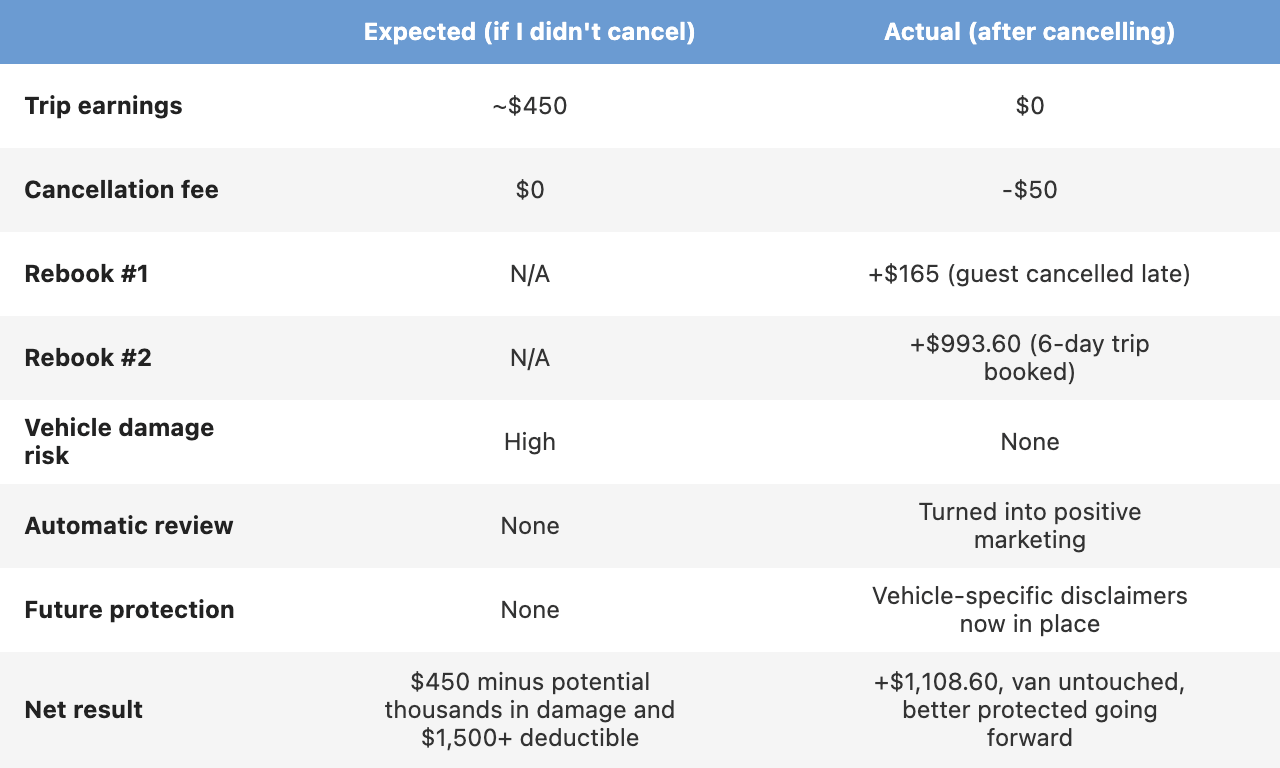
The Math on Cancelling a Risky Trip:

I'd rather lose $50 than lose my van for 9 months.
What Turo Did
I selected "uncomfortable with this trip" as my cancellation reason, which is the option Turo specifically provides for situations where a host has safety or policy concerns. Their own cancellation policy says hosts should use this when they have "reasonable concerns related to safety, harassment, and/or violations of Turo's policies."
Here's the full list of what a host cancellation triggers:
Host Cancellation Penalties:

I appealed. I laid out the vehicle specs, the fuel economy math, the prior damage experience, and the guest's own words. The first support agent ignored every point I made and sent a generic denial. Instead of addressing any of the actual reasons I cancelled, he implied I had cancelled for discriminatory reasons, citing Turo's nondiscrimination policy.
Nobody said anything about any of that. I cancelled because of what the guest told me he planned to do with my vehicle.
The irony? Turo's own Nondiscrimination Policy explicitly states that hosts may "decline or cancel reservations based on other factors" outside of protected categories. Their example: "a host can decline a guest who indicates a desire to tow a boat or film a commercial with the vehicle."
A guest telling me he's using my one-ton van for work on job sites but "just commuting" is like telling a host you'll be driving between the boat store and the lake a few times, but you're totally not towing a boat. Turo's own nondiscrimination policy supports the cancellation they penalized me for.
I escalated. The second agent was more thoughtful but the answer was the same: because the guest walked back his initial statement, my cancellation didn't qualify for penalty reversal. The guest's second answer apparently overrides his first, and my experience from running 10,000+ trips doesn't count as a legitimate basis for a business decision.
All penalties held.
Why I'd Do It Again
How This Trip Actually Played Out:

And the automatic review Turo posted as punishment? I responded publicly:
"Guest indicated they intended to use this passenger van for construction work on job sites. This vehicle has a premium leather interior designed for comfortable family travel and is not suitable for commercial hauling or job site use. We cancelled to protect the vehicle and ensure a great experience for future guests."
Turo meant the review as a penalty. It turned into reassurance for future guests that the vehicle is well cared for. A guest reading that review doesn't think "this host cancels trips." They think "this host protects their vehicles."
The Real Takeaway
Turo support doesn't run your fleet. They don't know your market. They've never watched a van come back from a job site with stained carpet, scratched moulding, and scraped paint on the rear doors that's still unrepaired because Turo wouldn't cover it. They've never spent 7 months and 8 claims reps trying to get paid for an engine a guest destroyed. They don't care about your car. You do.
After 10,000 trips, I trust my own pattern recognition over a support agent's script. Sometimes the right business decision is the one Turo penalizes you for. A $50 fee and a temporary review are manageable costs. A blown engine, months in a repair shop, and a deductible Turo won't waive are not.
You know your vehicles. You know your guests. You know what a sketchy booking looks like. Trust that, and don't let a $50 cancellation fee scare you into a decision you know is wrong.
Protect Yourself Going Forward
After this experience, I set up vehicle-specific welcome messages that go out automatically the moment a trip is booked. Turo lets you create scheduled message templates and assign them to individual vehicles.
For our vans, the message now includes: "This is a passenger van with a premium interior designed for comfortable family travel. It is not available for hauling materials, job site use, towing, or any commercial activity against Turo's Terms of Service."
For our 4x4 vehicles: "Off-roading, unpaved roads, and beach driving are prohibited under Turo's Terms of Service, this includes the Mauna Kea summit road."
Adjust the wording to match your vehicle. The point is to make it clear that your van is not a work truck or your SUV is not a trail rig, and to reference Turo's Terms of Service so it's framed as their rule, not yours.
If you have specialty vehicles that attract specific types of misuse, build a disclaimer into your automated booking message. It takes five minutes to set up and it creates a documented paper trail from the moment the trip is booked. Frame the language around Turo's Terms of Service, not your personal preferences. You're not making up rules, you're reinforcing the ones Turo already has. That positions you as the responsible host upholding platform policy, which is exactly where you want to be if you ever need to have a conversation with support.
And if you do cancel and Turo posts the automatic review, don't ignore it. Write a public response that explains why you cancelled, framed around protecting the vehicle and ensuring a great experience for future guests. You can't remove the review, but you control the narrative underneath it. A thoughtful response turns a penalty into proof that you take care of your vehicles.
Common Questions
Can Turo actually penalize you for cancelling when a guest states prohibited use?
Based on my experience, yes. If the guest walks back their initial statement, Turo treats the revised version as the one that counts. Your pattern recognition from thousands of trips doesn't factor into their decision.
Does the "uncomfortable with this trip" option protect you from penalties?
No. Turo says support is "automatically notified to review" these cancellations, but in my case both the initial agent and the escalation agent upheld all penalties.
Can you customize scheduled messages per vehicle on Turo?
Yes. Inside each scheduled message template, there's a "Select cars" option. Uncheck "All vehicles" and assign each template to the specific listing it applies to.
Is it worth eating a $50 cancellation fee to avoid a risky trip?
A blown engine cost us $1,625 out of pocket and $15,000 in lost revenue. A cancellation fee costs $50 and a temporary review. The math speaks for itself.
Doesn't the automatic review hurt your listing?
It can, but you control the narrative with your public response. A well-written response explaining you were protecting the vehicle reads as responsible hosting, not unreliability.
I run the financial operations of a 110-car Turo fleet remotely from the beach in Playa del Carmen, Mexico.